Introduction
Step on a smart scale, and you get more than a weight number. You see body fat percentage, muscle mass, water weight, even a "metabolic age." It feels precise. It often isn't.
Many users struggle with conflicting readings: one morning shows 22% body fat, the next shows 25%, with nothing in your routine actually changing.
A 2008 study comparing consumer BIA devices against reference methods found wide individual-level disagreement, even when group-level correlations looked strong.
This article breaks down how these scales actually work, what changes your readings, how to measure consistently, and when a professional assessment makes more sense than a bathroom scale.
Key Takeaways
- Body composition scales use bioelectrical impedance analysis (BIA) to estimate, not directly measure, fat and muscle.
- Hydration, meals, exercise, and device setup all shift your readings, sometimes significantly.
- Home scales work best for spotting trends over time, not pinpointing an exact body fat percentage.
- DEXA and professional assessments offer greater precision when accuracy truly matters.
- Always interpret a single reading alongside other data and qualified guidance.
What Body Composition Scales Represent and How They Work
Body composition describes how your weight breaks down: fat mass, lean mass, body water, and other components. This differs from total body weight or BMI, which only account for total mass relative to height. Two people can weigh the same and have completely different fat-to-muscle ratios.
BIA: The Technology Behind the Numbers
Most smart scales rely on bioelectrical impedance analysis. A low electrical current runs through your body, and the scale measures resistance, called impedance. An algorithm then combines that impedance reading with your height, age, sex, and weight to estimate body composition.
What's Measured vs. What's Estimated
Here's the distinction that matters most: the scale directly measures electrical resistance and your weight. Everything else is a calculated estimate built from an equation, not a direct reading. That includes body fat percentage, muscle mass, visceral fat, bone mass, metabolic age, and basal metabolic rate.
Water-rich tissues, like muscle, generally conduct electrical current more easily than fat tissue does. This difference is what lets BIA infer composition. But that relationship shifts with hydration status and how fat is distributed across your body, which is exactly why readings can swing day to day.
Electrode Design Matters
Not all scales sample your body the same way:
- Foot-to-foot scales send current through your legs and lower trunk only.
- Hand-and-foot models add grips, sampling a longer path through your upper body too.
- Professional multi-frequency or segmental devices use multiple electrode sites and frequencies for a more detailed regional picture.
None of these categories is infallible. A professional device isn't automatically "accurate" just because it's more complex, but it typically samples more of the body than a basic foot-only scale.
Accuracy, repeatability, and usefulness are not the same thing. A scale can miss an exact clinical reference match and still track change well. That only holds when you use the same device under the same conditions over months.

Factors That Influence Accuracy and Interpretation
A controlled lab measurement and your bathroom at 7 a.m. are not the same testing environment. Small, everyday changes in your body can shift the reading even when your actual composition hasn't moved at all.
Hydration and Fluid Distribution
Your body's water content isn't static. Dehydration, a big glass of water, swelling, and menstrual-cycle-related fluid shifts all change how current moves through your tissues. Tanita, a major scale manufacturer, specifically warns that illness, alcohol, menstruation, and bathing can all alter composition readings on its consumer devices.
Food, Exercise, and Timing
- Meals add weight and temporarily shift fluid balance.
- Caffeine and alcohol can affect hydration status.
- Recent exercise redistributes blood flow and body water.
- Time of day shifts readings as hydration fluctuates from morning to evening.
Compare readings taken under similar circumstances; don't compare a post-workout evening reading to a fasted morning one.
Device and Setup Variables
Small setup details change results more than people expect:
- Scale calibration and battery condition affect measurement stability
- Clean, bare-skin contact with the electrodes is required for a clean signal
- A firm, level surface matters—carpet or uneven flooring skews readings
- Correct personal profile data (height, age, sex) keeps the estimate on-model
Algorithm and Personal Characteristics
Manufacturers use different proprietary equations, and results vary by age, sex, body size, fitness level, and other characteristics. A 2024 systematic review of BIA prediction equations found that equation suitability depends heavily on the specific device and population tested.
Estimates from different brands should not be treated as interchangeable. Switching scales mid-tracking introduces noise that has nothing to do with your actual body changing.
Range, Key Properties, and Meaning of the Measurements
There's no universal "normal" number that applies across every scale, every body, and every method. Interpretation depends on the person, the device, and why you're measuring in the first place.
Conditions for Consistent Readings
A home reading is most comparable to your other readings when you control for:
- The same scale, used consistently
- A similar time of day
- Consistent hydration status
- Similar pre-measurement activity
- Correct, unchanged user settings
A manufacturer's displayed precision, such as body fat to one decimal point, is not the same as validated accuracy. That decimal point reflects display resolution, not proof the number is correct. Check your device's manual and any independent validation research before assuming otherwise.
Stability and Variability
Day-to-day swings in water, food in your digestive tract, glycogen stores, and bowel contents all create movement in your displayed numbers. None of that represents an equivalent change in actual fat or muscle tissue. A three-pound jump overnight is almost certainly water, not fat.

Derived Metrics and Their Limits
Visceral fat ratings, skeletal muscle percentages, bone mass estimates, and metabolic age are often proprietary indices, not standalone diagnoses. Treat them as relative indicators from that specific device, not universal clinical measurements.
Weight, body fat, lean mass, and water change at different rates. Progress should be assessed with multiple indicators, not a single percentage on one screen.
When to talk with a professional: If a pattern persists for weeks, conflicts sharply with how you look or feel, or coincides with other health changes, discuss it with a qualified professional. A consumer scale is not a tool for self-diagnosis.
How to Measure, Validate, and Use Results Responsibly
Good technique improves consistency. It cannot turn an estimate into a definitive clinical test.
Before You Step On
- Place the scale on a hard, level surface, never carpet.
- Verify your profile details are current and accurate.
- Follow manufacturer guidance for your specific model.
- Avoid measuring immediately after exercise or unusual food and fluid intake.
- Check safety warnings before each use.
During and After Measuring
Follow the same routine each time you measure:
- Stand in the required position with stable, clean skin contact
- Record the date, time, device used, and relevant circumstances (late workout, salty dinner)
- Review trends across multiple readings instead of reacting to one outlier
Comparing Methods
A 2021 observational study comparing three smart scales against DEXA found the scales performed substantially better at estimating weight than at estimating body composition. Researchers advised against substituting them for DEXA in clinical decision-making.
| Method | What It Offers | Main Trade-Off |
|---|---|---|
| Home BIA scale | Convenient, repeatable trend tracking | Equation-dependent, limited precision |
| Professional BIA (e.g., InBody) | More electrode paths, segmental detail | Still an estimate, not a direct measurement |
| DEXA scan | Common clinical/research reference standard | Cost, access, small radiation dose |
| Skinfold calipers | Portable, inexpensive | Depends heavily on assessor skill |
| Waist measurement | Simple, accessible risk indicator | Doesn't estimate full body composition |
Professional Interpretation and Enrich Gifts
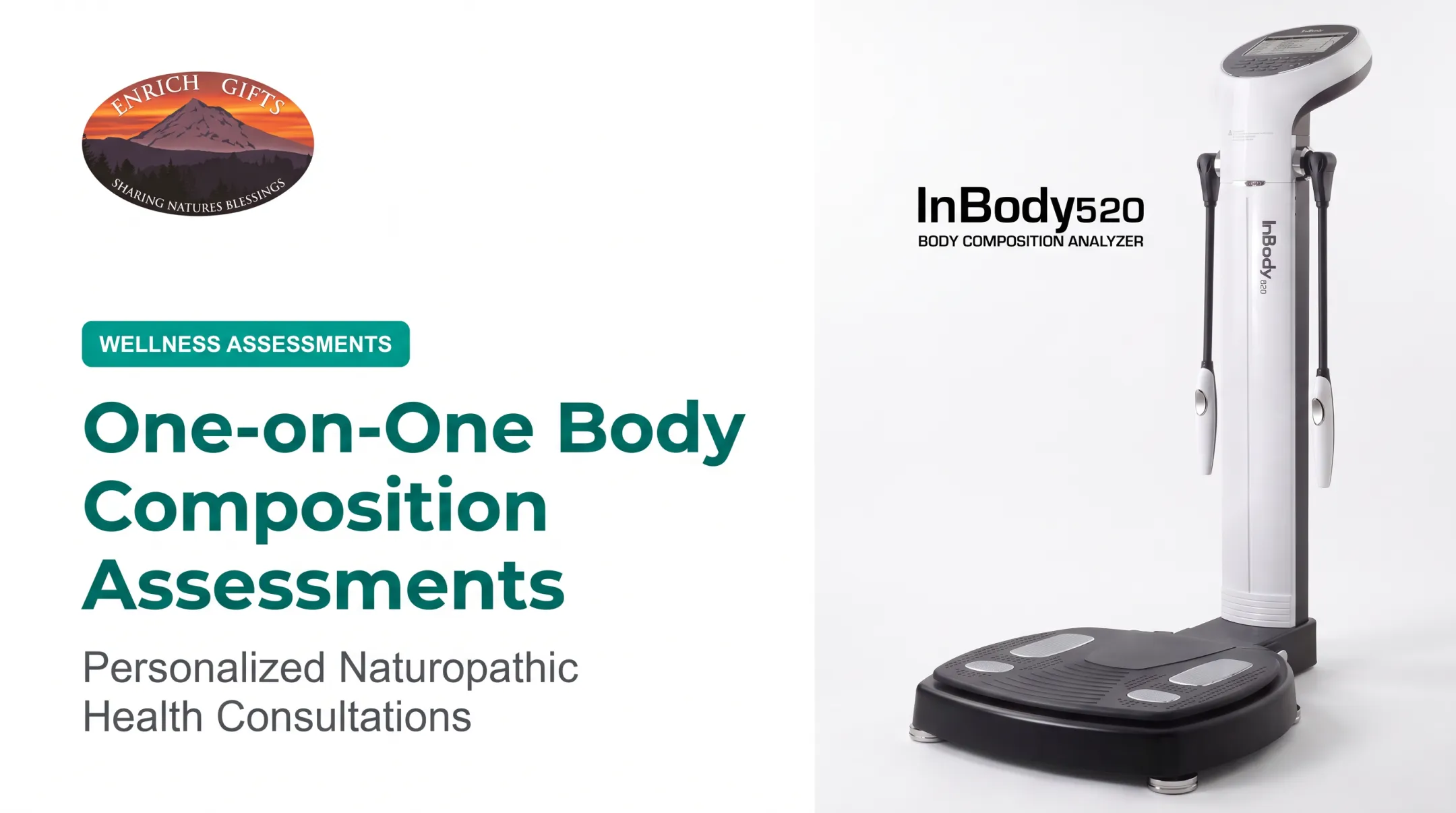
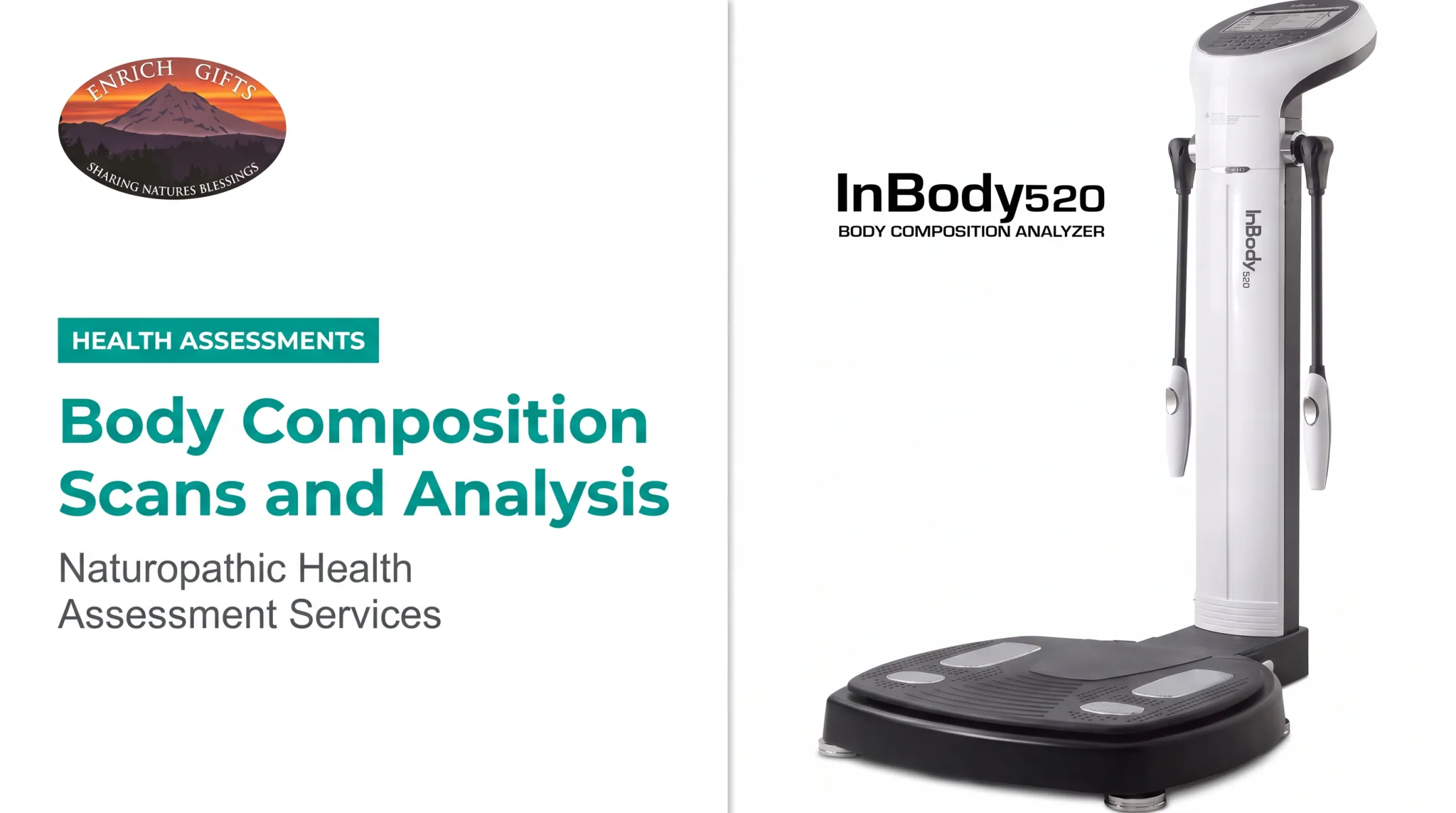
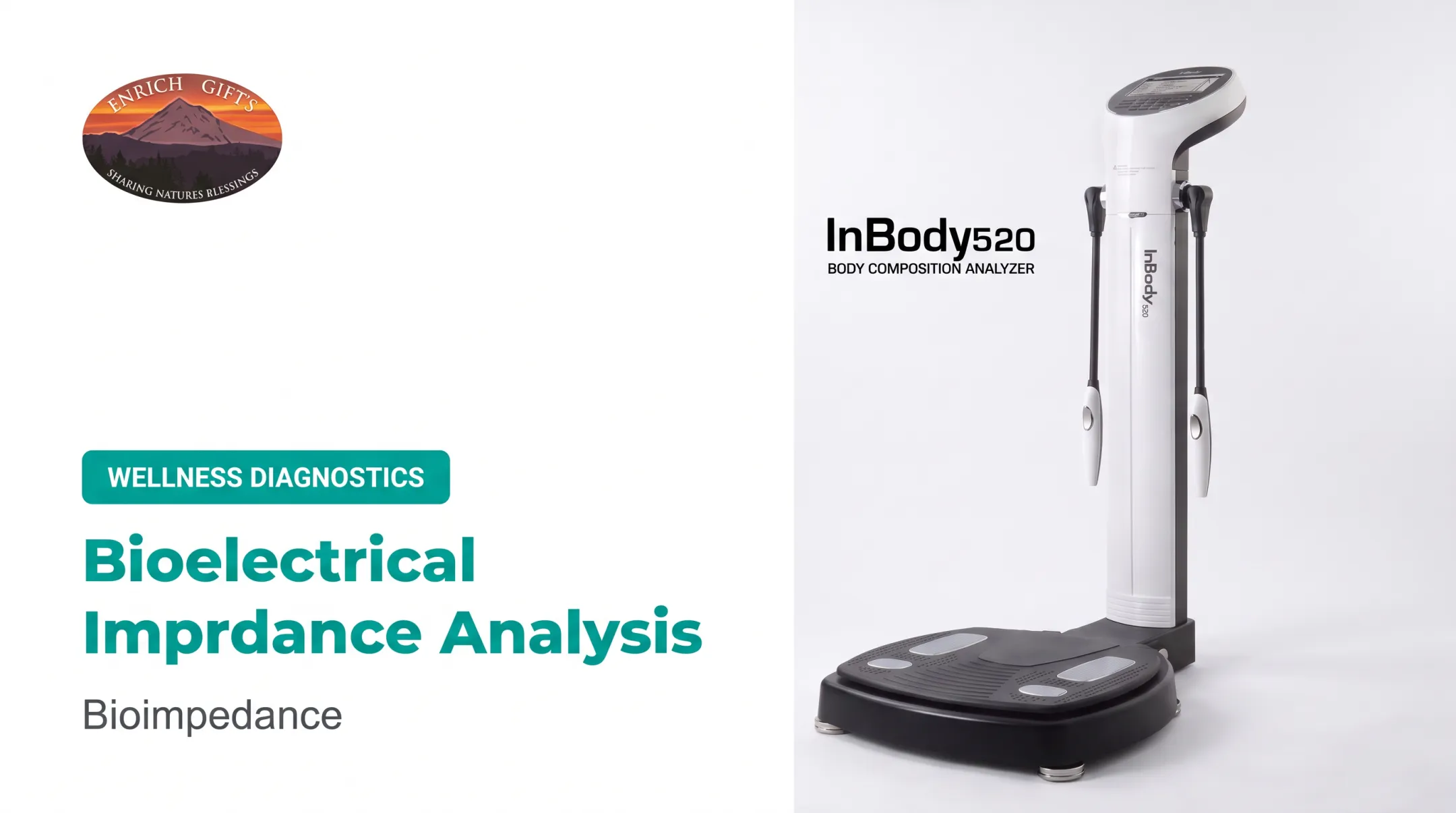
For readers who want more structure than a bathroom scale provides, Enrich Gifts offers InBody 520 analysis as part of its functional health assessment services in Arlington, Texas.
The InBody 520 uses very mild electrical currents, is radiation-free and non-invasive, and completes a scan in under 45 seconds. It generates a printable color report covering lean body mass, water mass, skeletal muscle mass, and body fat mass.
Dr. Carolyn Johansen, N.D., reviews these results alongside lifestyle factors as part of personalized naturopathic guidance. InBody testing complements lab work and imaging; it does not replace them, and it is not a guarantee of diagnostic precision.
When Greater Precision Is Important
Seek advice from a qualified healthcare professional when you:
- Notice unexplained changes in readings
- Have significant health concerns
- Are pregnant
- Are recovering from an eating disorder
- Have an implanted electronic device
- Need clinically significant measurements for medical decisions
Implications of Operating Outside Recommended Conditions
Using a scale after exercise, with inconsistent hydration, on an uneven surface, or with wrong profile data reduces comparability. What looks like a body composition change may just be measurement noise.
Beyond these environmental factors, a common mistake is treating a displayed percentage as a directly measured fact. Visceral fat ratings, muscle mass, bone mass, metabolic age, and basal metabolic rate are all estimates, not measured facts.
A British Journal of Nutrition study testing 15 BIA devices found that roughly 47% of tested models showed significant bias. Many also failed to track actual composition change over time, even though repeat readings looked consistent.

Avoid these common missteps:
- Comparing readings from different scale brands or models
- Interpreting a single day's fluctuation as fat gain or muscle loss
- Using a home device to diagnose or rule out a medical condition
- Ignoring a reading that conflicts with visible changes, performance, or medical results
Safety note: Follow your device's contraindications. If you're pregnant or have a pacemaker, defibrillator, or other implanted electronic device, ask a healthcare professional before using impedance-based measurements. Manufacturer instructions vary by model.
Conclusion
Body composition scales are estimation tools, shaped by BIA technology, your personal inputs, the manufacturer's algorithm, and your body's constantly shifting conditions. None of that makes them useless. Used consistently, with the same device under similar conditions, they're genuinely helpful for spotting broad trends over weeks and months.
They shouldn't be treated as an exact body composition result or a medical diagnosis. Combine scale data with other indicators such as waist measurements, how your clothes fit, and how you feel, plus qualified professional guidance whenever accuracy or health interpretation actually matters.
Frequently Asked Questions
Is BIA as accurate as DEXA?
BIA and DEXA use fundamentally different methods, and accuracy varies by specific device and testing conditions. Consumer BIA is generally better suited to trend monitoring than to replacing a professionally indicated DEXA assessment.
Is 4 lbs of visceral fat a lot?
Consumer scales often estimate visceral fat using proprietary scores rather than direct measurements in pounds. That displayed value may not be comparable across brands, so don't judge health risk from this number alone.
Is 38% skeletal muscle good?
What counts as "good" depends on the device, your age, sex, body size, and measurement conditions. Track your own trend over time and discuss any concerns with a qualified professional rather than comparing to a generic benchmark.
How accurate are body composition scales at home?
Home scales are useful for consistent trend tracking under repeatable conditions, but they may not precisely determine your exact body fat or muscle percentage. Treat the number as a directional signal, not a lab result.
What can affect a body composition scale reading?
Hydration, recent food and drink, exercise, time of day, skin contact, scale placement, calibration, your personal profile settings, and the device's underlying algorithm can all shift your reading.
How should I use a body composition scale to track progress?
Use the same device under similar conditions each time, measure periodically rather than daily, and focus on longer-term patterns. Seek professional advice if results seem unexpected or clinically significant.